
Join the Pigsfly Movement! Support bold, ad-free commentary with a membership today. Click below to keep the truth flying high!

MYEFO 2018

They are the two rules that have defined the Coalition’s economic management – budget repair and a “speed limit on taxes”. On Monday, they found themselves on the final stretch of the collision course they have been hurtling down for years.

We now know how this crash will turn out.

The government’s own rule book, reprinted in Monday’s mid-year economic update states: “The overall impact of shifts in receipts and payments due to changes in the economy will be banked as an improvement to the budget bottom line.”

MYEFO reveals billions more in revenue, $9 billion in fresh election tax cuts

Peter Martin, The Conversation

Higher-than-expected company tax revenue and lower-than-expected spending have boosted the budget’s bottom line by A$14 billion over next four years, allowing it to forecast cumulative surpluses of A$30.4 billion, double what the budget predicted in May.

Modestly improved surpluses

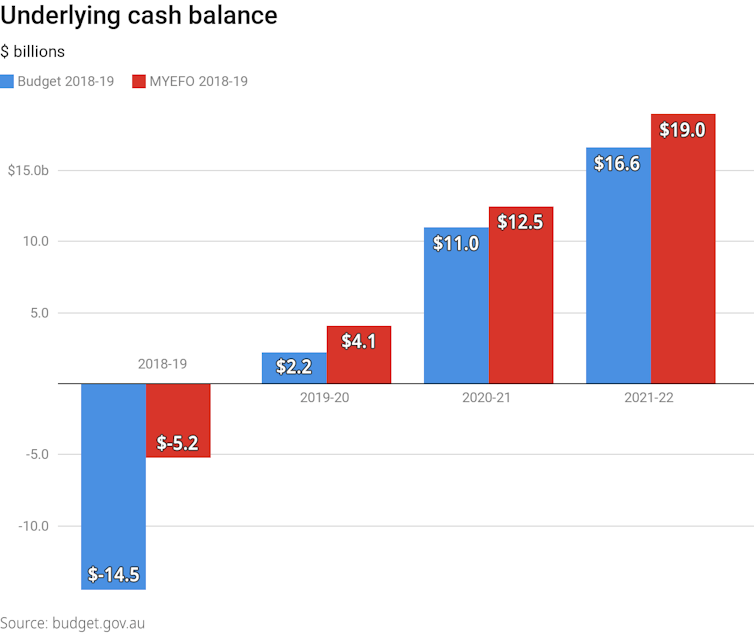
The midyear budget update cuts the projected deficit for 2018-19 from a May estimate of A$14.5 billion to A$5.2 billion.

The surplus forecast for 2019-20 climbs from A$2.2 billion to A$4.1 billion. By 2021-22 the surplus is forecast to be A$19 billion, up from A$16.6 billion.


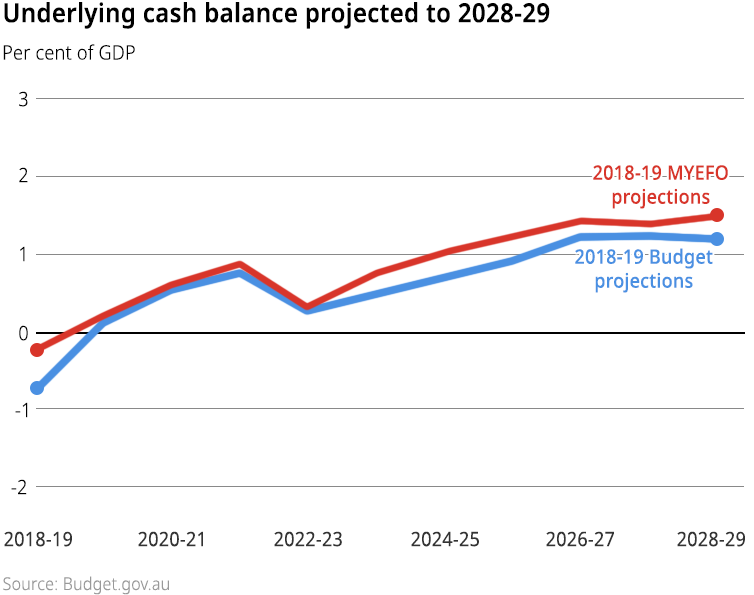
The surplus won’t reach the government’s long-term target of 1% of gross domestic product until 2025-26. And in projections out to 2028-29 it is not forecast to climb much above this target as the budget hits the Coalition’s self-imposed tax “speed limit” of 23.9% of GDP.


$9 billion in unannounced tax cuts

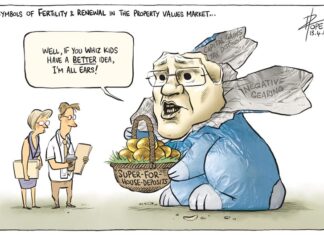
The budget boost would have been much bigger were it not for more than A$9 billion in “decisions taken but not announced”. Almost all of these are revenue decisions, presumably extra election tax cuts, worth A$2.5 billion to A$3.7 billion per year.

The budget papers say these are decisions taken since the May budget, and are either not for publication or haven’t yet been made public.


Read more:
More mirage than good management, MYEFO fails to hit its own targets


Treasurer Josh Frydenberg confirmed the government had taken decisions to do with tax, but said it would announce them at a time of its choosing rather than in the budget update.

It reserved the right to take other tax and spending decisions in the lead-up to the election. Some would be revealed in the 2019-20 budget, to be delivered in April rather than in May to allow an election in May.

Downgraded wage growth

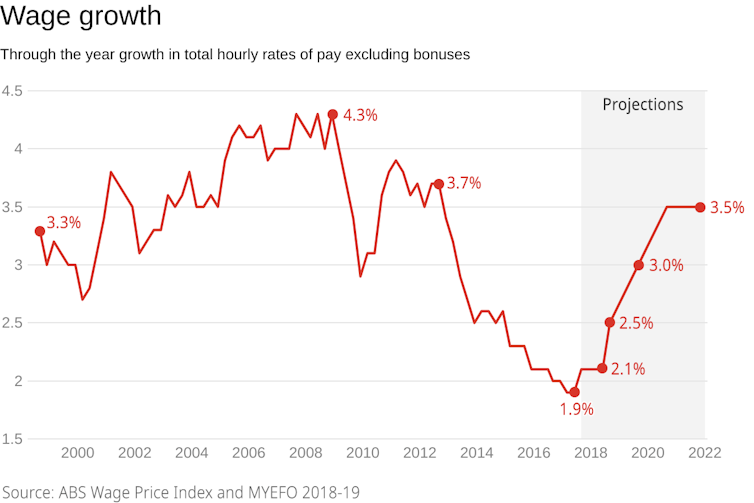
Although the Treasury has revised up its estimates for revenue and revised down its estimates of unemployment, expecting the rate to fall to 5% by June 2019 and stay there, it has shaved 0.25 percentage points off its estimates for wage growth.

It now expects wages to grow by 2.5% in the year to June 2019 (down from 2.75%) and 3% in 2019-20 (down from 3.25%). In future years, it expects wage growth of 3.5%.


Addressing the downgrade, Mr Frydenberg said weaker-than-expected wage growth appeared to be part of a worldwide phenomenon, “not unique to us”.

Wage growth for the year to September was 2.3%, the highest since 2015. The statement said anecdotal evidence from Treasury’s business liaison program pointed to “skills shortages and wage pressures in some sectors of the economy, consistent with a tightening labour market”.

Weaker consumer spending, economic growth

Growth in consumer spending has also been revised down, from 2.75% in 2018-19 to 2.5%. It is expected to climb back to 3% in 2019-20.

The statement revises down the government’s forecast of economic growth in 2018-19 from 3% to 2.75%, in part because of the Queensland drought, but predicts growth of 3% in 2019-20, 2020-21 and 2021-22, a touch higher than the Treasury’s estimate of long-term sustainable growth.

But debt has peaked and is headed down

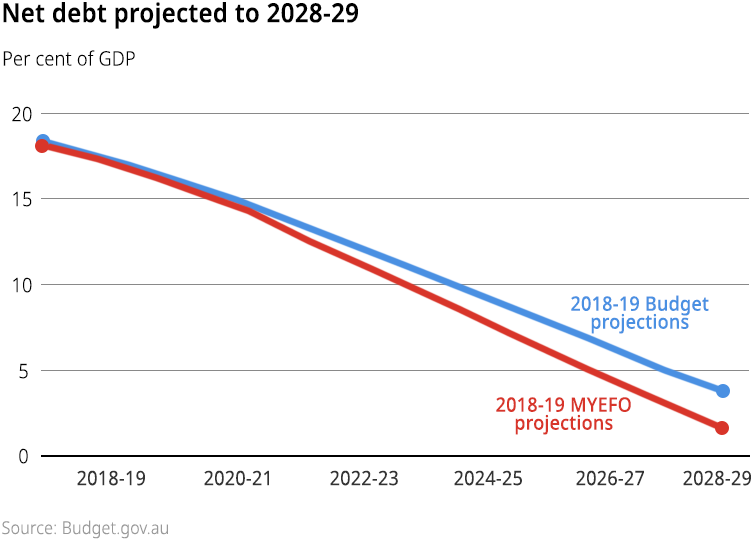
The updated figures show net debt has already peaked as a proportion of GDP and will fall faster than previously expected, in line with higher surpluses, sliding from 18.2% of GDP to 1.5% over the decade to 2028-29.


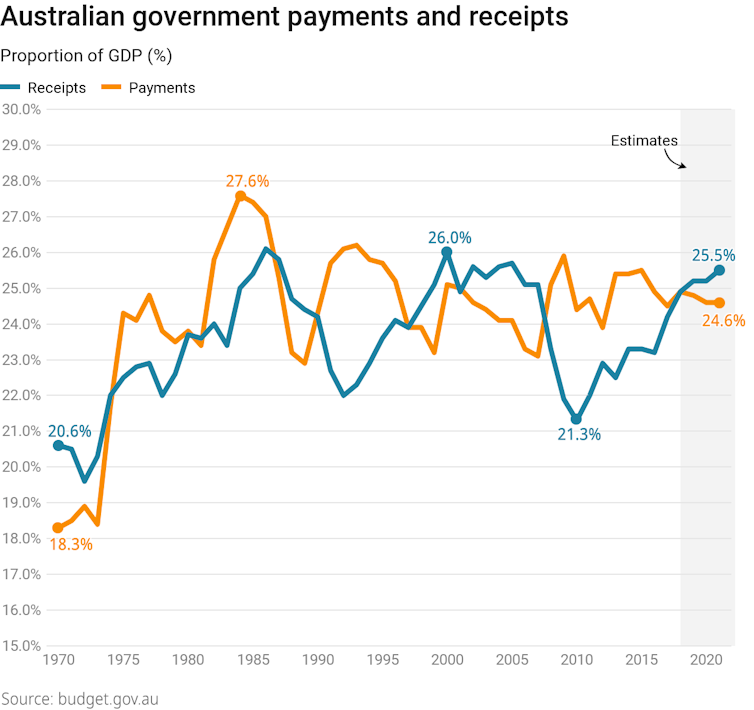
Government receipts are expected to climb from 24.9% of GDP to 25.5% by 2021-22. Payments are expected to fall from 24.9% of GDP to 24.6%.

Mr Frydenberg said the Coalition had kept average real spending growth at 1.9% per year, well below Labor’s 4% over six years which included the global financial crisis.


Finance Minister Mathias Cormann said recurrent spending had fallen below recurrent revenue for the first time in more than a decade.

Recurrent spending excludes spending on long-term investments in things such as road and rail infrastructure.

He said all new spending since the May budget had been offset by spending cuts elsewhere.

No firm commitment on fiscal discipline

Asked whether he felt bound by a commitment in the budget papers to bank rather than spend improvements to the budget’s bottom line due to changes in the economy, Cormann said it was “a matter of balancing priorities”.

The imperative to cut tax to keep it below the government’s self-imposed speed limit might conflict with the commitment to devote extra tax takings to improving the bottom line.


Read more:
Monday’s MYEFO will look good, but it will set the budget up for awful trouble down the track


The Conversation


Peter Martin, Editor, Business and Economy, The Conversation

This article is republished from The Conversation under a Creative Commons license. Read the original article.

Adani – Interactive cost, environmental impacts, jobs and the future

0
Interactive: Everything you need to know about Adani – from cost, environmental impact and jobs to its possible future ABC News: Nationwide, a majority of voters...

Murray Darling Fish Kill is Neoliberalism working

0
Initially this newspaper proposed that the Murray Darling Basin catastrophe was the proverbial “Canary in the Coal Mine” and the fish kill was but...

The Robodebt Royal Commission is hearing damning evidence of public sector...

0
Laura Tingle 7.30's chief political correspondent writes. The commission was also shown minutes from a meeting between the DHS and PwC in March 2017, in...

Britain’s Slave Owner Compensation Loan, reparations and tax havenry

0
So basically, my father and his children and grandchildren have been paying taxes to compensate those who enslaved our ancestors, and you want me...

Is it the economy or not, stupid?

0
Yesterday’s shocking inflation figure and the impending interest rate rise have brought the election campaign firmly back into economic territory, with a renewed focus...

Corporate lobbying a billion dollar business

0
An analysis of the financial statements of 20 of Australia’s major business lobbies found almost $2 billion in funding by corporations over the past...

🔥 WOOLWORTHS: BAIT, SWITCH & PROFIT – A Corporate Cash Grab...

0
You shop smart. You see a half-price deal and add it to your Woolworths Direct to Boot order. But when you check your receipt? BAM!...

Google’s Paris offices raided by tax investigators

0
French police and prosecutors have swooped on Google’s Paris offices, intensifying a tax-fraud probe amid accusations the Internet giant fails to pay its fair...

The public should be ‘shocked, dismayed and disgusted’ at the major...

0
The public should be 'shocked, dismayed and disgusted' at the major banks ANZ and NAB have settled with ASIC over manipulation of the Bank Bill...

When Cringe Meets Cash: The Queensland Government’s Big, Smiley Bailout 🤡💸

0
Well, well, well. If it isn’t Queensland’s very own version of a snake oil salesman, Premier Steven Miles—oops, did we say miles? We meant...

Paradise Papers

0
A trove of 13.4 million records exposes ties between Russia and U.S. President Donald Trump’s billionaire commerce secretary, the secret dealings of the chief...

Hayne’s failure to tackle bank structure means that in a decade...

0
Hayne’s failure to tackle bank structure means that in a decade or so another treasurer will have to call another royal commission Andrew Linden, RMIT...

History repeats: how O’Farrell and Greiner fell foul of ICAC

0
In April 2014, the New South Wales Independent Commission into Corruption (ICAC) claimed its biggest political scalp in two decades. Liberal state premier Barry...

Three claims used to justify pulling codeine from sale without a...

0
Codeine Banned In Australia: Why The Arguments Don't Add Up Three claims used to justify pulling codeine from sale without a prescription, and why they're...

Tax office accused of ‘don’t ask, don’t tell’ culture on PwC...

0
The agencies most involved in responding to professional services giant PwC’s misuse of government information are facing growing concerns about their handling of the...
Join the Pigsfly Movement! Support bold, ad-free commentary $10 per year. Click below to keep the truth flying high!