

How much of the unions’ agenda a Shorten government would be willing to embrace?
On Thursday he had a double-header news conference, with two major, unrelated, announcements – a proposed new federal integrity body, and a plan for a Religious Discrimination Act. In normal times, each would have had its own day in the spotlight.

The Coalition’s proposed Commonwealth integrity commission has also drawn criticism for its lack of public hearings and treatment of politicians
Grattan on Friday: Unions likely to be more challenging for a Shorten government than boats
Michelle Grattan, University of Canberra
In this week’s Newspoll 55% believed Labor would win next year’s election, compared with just 24% who thought the Coalition would. These are figures to frighten Scott Morrison, and make Bill Shorten just a touch nervous.
 If most people think the government is finished, it is hard for Morrison to get their attention – though he is certainly trying hard enough, with his frenetic activity.
On Thursday he had a double-header news conference, with two major, unrelated, announcements – a proposed new federal integrity body, and a plan for a Religious Discrimination Act. In normal times, each would have had its own day in the spotlight.
Shorten might be privately very confident, while doing his best to avoid giving the government evidence to back its accusation he’s measuring those Lodge curtains. But an overwhelming expectation of an ALP victory must also produce niggling fears in Labor ranks: could something derail what appears a relatively straightforward ride ahead?
The strong belief Labor will triumph could have contrary effects on voters. It might encourage some to get behind the likely victors. But the Liberals could also use it to frighten wavering supporters back into the fold.
In the lead up to next week’s ALP national conference, which Shorten needs to run smoothly, the government has been trying to exploit what it sees as a Labor weak point – border protection.
It homed in on the opposition’s support last week for the proposed amendment to facilitate medical transfers from Nauru and Manus. (This was the legislation the government prevented reaching the lower house, because it would have lost the vote.)
Around the edges of asylum seeker-refugee policy there are distinctions between the two sides. But on the central element of border protection – turnbacks – they are at one.
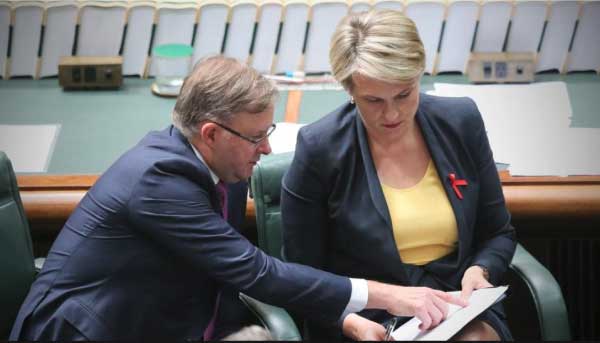 Key Labor left figures including Anthony Albanese and Tanya Plibersek have put aside doubts to ensure the government can’t drive in a wedge.
Another factor is helping Labor against the Coalition’s scare campaign – without boats arriving, the issue has slipped lower with voters. There has been a softening in community views – the public are more open to appeals for compassion towards those on Nauru and Manus.
Whatever vulnerability the ALP has in this area comes from previously allowing the boats to restart. Probably the people smugglers would test a Shorten government early on. But knowing the stakes, and remembering what happened before, it’s a sure bet that government would respond robustly.
The area of greater uncertainty under Labor is a very different one – that is, how much of the unions’ agenda a Shorten government would be willing to embrace.
Notably, the opposition still has to fill in key gaps in its industrial relations policies. Some commitments are clear, including the promise to restore penalty rates. On other matters the detail isn’t there yet – such as how broadly an ALP government would permit the
reintroduction of industry-wide bargaining. We only know its priority would be low paid industries.
 Workplace relations spokesman Brendan O’Connor addressed the National Press Club this week, but didn’t make announcements. He promised Labor would have “more to say” on multi-employer bargaining, the right to strike, the minimum wage, and addressing the gender pay gap.
Just as the ALP conference will be kept in line by the approaching election, so (at least to a degree) so will the ACTU over coming months. It desperately needs a Labor government.
The trade unions’ resources – money and manpower – will be of huge benefit to Shorten in the election campaign. Harder to predict is how they would operate under and with a shorten government.
In this context, a useful reference point is the “accord” the Hawke government had with the union movement. That was a highly productive, co-operative association, which enabled the government to make reforms vital to opening the Australian economy.
Shorten said this week he wanted to bring employers, unions and the government together in his first week in office, although there’s no suggestion of any “accord” framework with the unions.
 It is hard to imagine ACTU secretary Sally McManus, an industrial radical, having the sort of symbiotic relationship with a Shorten government that then secretary Bill Kelty had with Bob Hawke and Paul Keating.
Morrison tries to demonise Shorten’s union background and links, labelling him “union bred, union fed and union led”.
Common sense and history indicate a union background can be a positive for public policy, as Hawke demonstrated. On the other hand,  there are legitimate questions about what influence can be wielded on a prime minister whose power base is in sections of the union movement, including the CFMMEU. Until Labor releases its full industrial relations policy we can’t start to get a grip on how this would likely play out.
Labor has been working for months to manage next week’s conference, to avoid it detracting from the impression of an alternative government fit for office. In contrast the government struggles with its image in a more ad hoc manner.
Monday will be a good day for the government – the budget update will see impressive numbers. But on particular issues, it is another story.
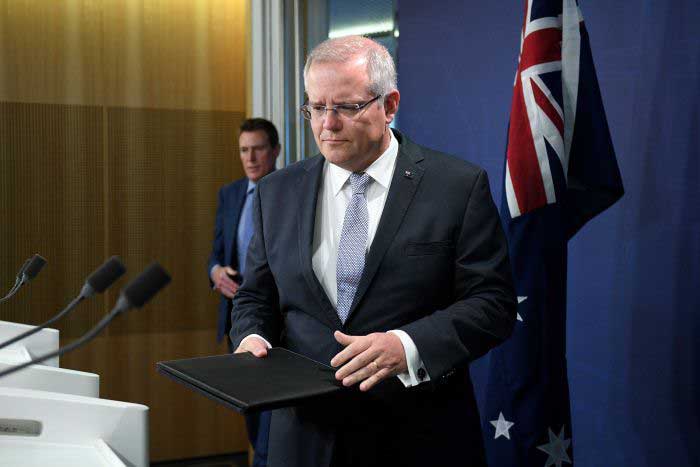 Take Thursday’s announcements. The Commonwealth Integrity Commission isn’t something the government actually thinks is needed or even a good idea. Rather, it is a counter to Labor’s policy and aimed at mollifying the public and the crossbench. But it immediately came under attack as inadequate, and the conditions put on it will be seen as letting politicians off the hook.
The religious freedom measures had their genesis in the unhappiness on the right over same-sex marriage. But many voters will regard them as a side issue or worse; meanwhile the right wing Institute of Public Affairs condemned them as an attempt to “regulate religion” and “a significant threat to the freedom of conscience of all Australians.”
Neutralising negatives is critical for both sides in the run up to an election. At this point, Labor is making a much better fist of it than the government.
Michelle Grattan, Professorial Fellow, University of Canberra
Will Australia be caught short as politicians sacrifice the national interest...