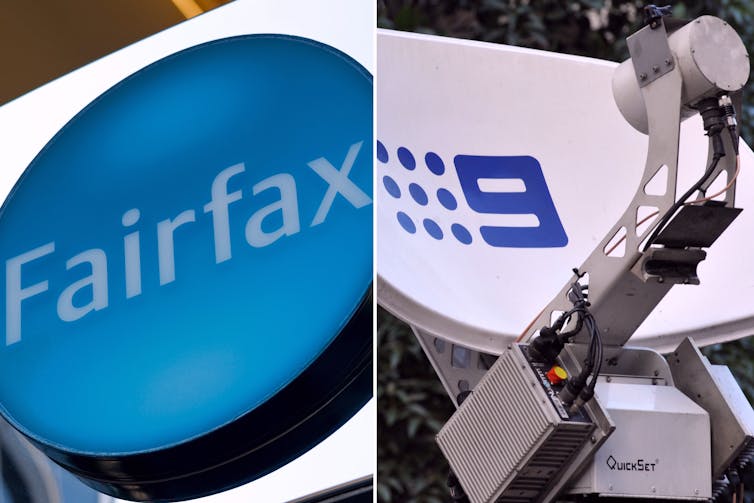
Fairfax has a charter of editorial independence, which all owners since 1990 have signed up to. Will Nine sign up to it? Will the charter have any meaning when the newspapers are owned by a company whose chairman, Peter Costello, was treasurer in the Liberal-National Coalition government of former Prime Minister John Howard?
The players
When the federal government opened the door to the possibility of new ownership constellations in the industry by relaxing media laws in October last year, Nine didn’t have its ducks in a row. It wasn’t in a position to make a serious proposal.
All media players had since been circulating their dance cards, but Fairfax was always the centrepiece of any big deal.
Seven was having discussions with Fairfax, but apparently Kerry Stokes – or more to the point, his son Ryan Stokes – was a seller of media assets rather than a buyer.
The “revolving door” of politics – the means by which government officials leave office to become lobbyists, and by which lobbyists become government officials – presents problems for modern democracies that largely go unrecognised, unaccounted for and unpoliced.
In certain respects, the revolving door is inevitable, a natural byproduct of political tragics fulfilling a varied career in politics. But when even the most senior politicians go on to work as lobbyists, it can profoundly undermine democracy.
Unprecedented access
A lobbyist’s efficacy primarily depends on their ability to gain access to decision-makers.
Working in government in any capacity provides knowledge that is invaluable to lobbyists. But the advantage is not merely informational: having worked with government officials means knowing them. It often means having had drinks with them, or knowing their loved ones’ names and birthdays, or their personal phone numbers.
Who lobbied the Government to relax the media rules? According to some media players and their reporters these changes occurred in isolation!
We are all expected to believe that the Federal ex Treasure Peter Costello with access to every Federal and State politician sat benignly on his hands.
It means the death of Fairfax and is the most consequential change in Australian media ownership in 31 years.
It also means that three of Australia’s best and biggest newspapers – The Age, The Sydney Morning Herald and The Australian Financial Review – are now subsumed into a media conglomerate whose editorial culture is characterised by mediocre journalism.
Nine’s news bulletins consist largely of police stories with a tincture of politics, and highlights of colourful or violent events overseas.
Its current affairs program, A Current Affair, is a formulaic procession of stories about consumer rorts and personal tragedies.
So there is a huge question mark over the future editorial quality of the newspapers.
A particularly pressing question is: what will happen to The Age’s investigative unit?
It is led by two of the best investigative reporters Australia has produced, Nick McKenzie and Richard Baker.
In addition to breaking an extraordinary range of major stories on subjects like organised crime and scandals in the banking industry, they have developed a highly successful collaboration with the ABC’s Four Corners team.
It seems very unlikely Nine would allow this collaboration to continue, since it involves a rival television channel.
There is also a question about editorial independence.
Fairfax has a charter of editorial independence, which all owners since 1990 have signed up to. Will Nine sign up to it? Will the charter have any meaning when the newspapers are owned by a company whose chairman, Peter Costello, was treasurer in the Liberal-National Coalition government of former Prime Minister John Howard?
The answers to these questions will not be known for some time. They will depend largely on who is given editorial control of the combined operation. Since the Nine CEO, Hugh Marks, is to be CEO of the combined operation, it seems more likely than not that it will be a Nine executive who calls the editorial shots, too.
The takeover also means a further loss of diversity in an already highly concentrated media-ownership landscape. The big players are now down to four: News Corp, Nine, Seven West Media and the ABC.
And it is almost certain to mean the loss of yet more journalists’ jobs.
Since 2012, more than 3,000 jobs have been lost across Australian journalism. Yet, if the takeover is really going to represent “compelling value” for shareholders, as Fairfax chairman Nick Falloon says, then newsroom “synergies” – to borrow the corporate jargon – are likely to be essential.
The Fairfax company’s death throes have been painful and prolonged.
They began in 1987, when the younger son of Sir Warwick Fairfax, “young Warwick”, privatised it. That meant buying out all the public shareholders, for which purpose “young Warwick” borrowed AU$1.6 billion from the National Australia Bank.
Even with the revenue from the “rivers of gold” then flowing in from the classified ads of The Age and The Sydney Morning Herald, “young Warwick” could not meet his debts to the bank, which promptly sold him up.
In a highly politicised auction, during which Paul Keating and the then-Labor prime minister, Bob Hawke, sought assurances from prospective buyers concerning political outlook, the company fell into the hands of a London-based Canadian, Conrad Black.
There followed a procession of ownership changes, board reshuffles and short-lived chief executives that left the company rudderless and vulnerable.
Shortly after the turn of the millennium, when the digital revolution began to engulf the media, a weakened and incompetently managed Fairfax was ill-equipped to respond.
A series of disastrous mistakes by successive boards resulted in Fairfax missing out on opportunities to buy into the new online advertising platforms in cars, jobs and real estate.
Hubris and arrogance led incumbent board members to believe that these markets could not function without the mountains of classified advertisements carried by The Age and Herald on Saturdays.
By 2005, the shift in revenue to online platforms was discernible, and the trend has been accelerating ever since.
As a result, the company was increasingly unable to meet the demands of the share market for profit growth, and so became the object of sustained takeover speculation.
When the federal government changed the laws in September last year to allow once again cross-media ownership between newspapers, radio, television and online, speculation about a merger between Nine and Fairfax grew stronger.
Today that speculation became a reality.
The Fairfax story has all the elements of Greek tragedy: heroism in the creation of the company, then a combination of comedy, pride, stupidity, greed, arrogance and hubris to bring it down.
Well, who could’ve seen this coming? (Spoiler: literally everyone with a functioning frontal cortex.) Today, a federal judge flushed Donald Trump’s long-gestating revenge fantasy against James...
It started innocently enough. Just another Tuesday, just another PDF to open.
A document I created myself.
But Adobe Acrobat had other plans.
Ransom ware disguised as...
There are corporate spinners, there are Olympic-level weasellers, and then… there’s Allianz Insurance Group — a company so deft at transforming disasters into dividends, they...
Free tickets, luxury suites, and chocolates from the gambling industry? No biggie! Our beloved politicians *swear* it’s just a coincidence that gambling ads keep...
For years, too many incumbent politicians in the United States seemed hypnotised by their own navels. They watched the room, counted the donors, nodded...
You Aren't "Bad with Tech."
The modern computer was designed to serve the company that built it, not the person using it. We're changing that.
GeniusDesk...