

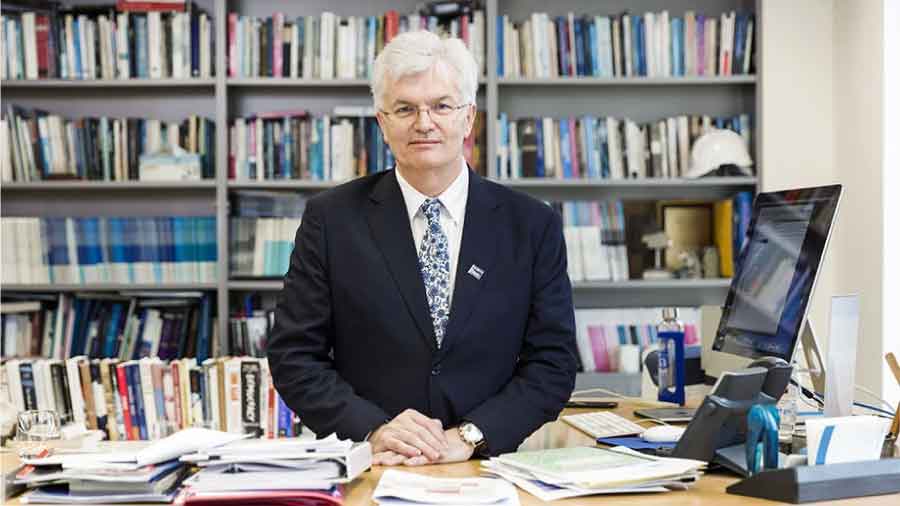
Albanese appoints former University of Melbourne vice-chancellor Glyn Davis to head PM&C
Michelle Grattan, University of Canberra
Anthony Albanese is bringing in an outsider, former University of Melbourne vice-chancellor Glyn Davis to head his Department of the Prime Minister and Cabinet.
Davis, who is close to former prime minister Kevin Rudd, was speculated on as a possible head of the department in Rudd’s time. In 2008 Davis co-chaired the Rudd government’s Australia 2020 Summit.
Currently Davis is CEO of the Paul Ramsay Foundation, Australia’s largest philanthropic trust.
He replaces Phil Gaetjens, who as secretary of the department under Scott Morrison came under criticism for being too political and, in the eyes of some bureaucrats, for not standing up strongly enough for the public service.
Davis was director-general of the Queensland department of premier of cabinet from 1998 to 2002.
He then became vice-chancellor of Griffith University, and in 2005 moved to be vice-chancellor of Melbourne University, a position he held until 2018, driving a major academic restructure. He retains a range of academic connections. His research interest has centred on public policy.
Announcing Davis’ appointment Albanese said he would bring to the role of secretary, “a deep understanding of public policy and will work with my government in bringing about positive change for the Australian people”.
Davis was a member of the Thodey review into the public service.
The Morrison government rejected a number of the more ambitious of that inquiry’s recommendations which would have constrained the hand of government in dealing with the public service.
There will be intense interest within the public service about whether Davis will urge the new government to revisit some of these Thodey recommendations.
Davis delivered the 2010 Boyer Lectures , which were published under the title The Republic of Learning. His appointment has been enthusiastically welcomed by the higher education sector.
Chief executive of Universities Australia Catriona Jackson said: “This is a pivotal appointment at a pivotal moment for Australia and Australians.
“Professor Davis’ extensive and distinguished experience in public policy and deep understanding of the importance of a strong university sector to Australia’s future, is well proven.
“As we emerge from challenging times, we look forward to working with Professor Davis to deliver the productivity gains that highly-skilled people and technological and social advances provide to the economy.”
Michelle Grattan, Professorial Fellow, University of Canberra
This article is republished from The Conversation under a Creative Commons license. Read the original article.
Anthony Albanese to create climate super-department in bureaucratic shake-up
Prime minister also plans to remove AFP from home affairs portfolio as he reshapes the public service
Katharine Murphy Political editor for The Guardian writes in today’s Guardian
Anthony Albanese will create a new mega-department of climate change, energy, environment and water to drive the new Labor government’s policy agenda.
The prime minister has also acted to remove the Australian federal police (AFP) from the home affairs department.
Albanese commenced Labor’s post-election shake-up of the bureaucracy earlier this week by appointing the former University of Melbourne vice-chancellor Glyn Davis to head up his own department.
Davis, who was mooted as a potential prime minister’s department’s head during the Rudd era, replaces Scott Morrison’s appointee Phil Gaetjens, a long time Liberal staffer and Treasury official.
Albanese late on Wednesday then unveiled his machinery of government changes after the swearing-in of his first cabinet and ministry.
In 2007, when Labor was last in government, Kevin Rudd established the Department of Climate Change, and after the 2010 election Julia Gillard bolstered the department by bringing energy into the new Department of Climate Change and Energy Efficiency.
But that structure was abolished in 2013 by Tony Abbott when he repealed Labor’s carbon pricing scheme. The department’s functions were split between the Department of Industry, Innovation, Climate Change, Science, Research and Tertiary Education and the Department of Resources, Energy and Tourism.
Albanese said he would establish a new Department of Climate Change, Energy, the Environment and Water to advise the government on implementing its suite of climate policy measures, including the new 2030 emissions target and tweaks to the safeguard mechanism, and a reboot of the national environmental agenda.
Albanese also plans to adjust the Department of Home Affairs. As part of a reconstruction remit, the department will gain responsibility for natural disaster response and mitigation, including the National Recovery and Resilience Agency.
But the AFP would shift to the attorney general’s portfolio, which would assume responsibility for criminal law enforcement and policy.
The Department of Home Affairs was first established by Peter Dutton, with its bureaucratic structure championed by the current secretary, Mike Pezzullo, since he worked as an adviser to the former Labor leader, Kim Beazley, in 2001.
The AFP was one of five operational agencies and bodies that were incorporated in the home affairs portfolio.
- Others included the Australian Border Force,
- the Australian Criminal Intelligence Commission,
- the Australian Transaction Reports and Analysis Centre, and
- the Australian Security Intelligence Organisation (Asio).
The Australian Federal Police Association has campaigned in the past to have the AFP excised from home affairs, arguing the structure was putting its independence and integrity at risk.
Dutton’s desire to create the super-department was also controversial within the Turnbull government. George Brandis, who served as Turnbull’s attorney general, reportedly used a farewell speech at Asio to raise concerns about the power and scope of the home affairs apparatus.
Albanese has, as part of his bureaucratic changes, also chosen to rename the Department of Health as the Department of Health and Aged Care.
The Department of Infrastructure, Transport, Regional Development and Communications would also be renamed the Department of Infrastructure, Transport, Regional Development, Communications and the Arts.
He has also shifted responsibility for data policy, including the Digital Transformation Agency, to the Department of Finance.