

I just want a Ferrari, sorry, a nuclear submarine, no matter the cost
Prime Minister Anthony Albanese has just committed Australia to spending $368 billion on somewhere between three and five second-hand US Virginia Class submarines, and a follow on build of eight next generation British AUKUS nuclear submarines. It’s a strategic blunder, writes former submariner Rex Patrick, and it’s not even going to happen the way the PM has suggested.
I just want a Ferrari. All my mates tell me they’re great cars. Never mind that, financially, I’m already struggling to keep up with the house repayments and, over time, the wife and kids are going to have to miss out on some of life’s niceties and even essentials; no orthodontic treatment to straighten my daughter’s teeth, no tutor to assist my son through extension maths and the wife won’t be able to afford to go back to uni to get her masters.
But I’ll look good cruising down Jetty Road at Glenelg in my shiny red machine. Now, just between you and me, the Ferrari’s not so good for going off-road or towing the family caravan, but hey, otherwise it is a great car.
Nuclear capability
Coming back from my Ferrari dream, it’s true that nuclear submarines are good. I know, because I’ve spent time at sea on them.

Rex at Sea on USS Santa Fe
There’s nothing like taking the submarine down to 200 metres and turning up the power on the reactor to get to 30 knots, and then staying there, knowing you have almost unlimited power. It allows you to deploy great distances, arriving quickly. That’s important for the power projecting nations that sit as permanent members of the United Nations Security Council; China, France, Russia, the UK and the US all have nuclear submarines.
But Australia is not a power projecting nation.
Our first priority is supposed to be defence of Australia, and our Defence Force should be configured for that, first and foremost. Even those who think we must automatically join the US in a war against China need to understand US strategy and what Australia’s role would likely be.
China depends on imports for 72% of its oil consumption, and the overwhelming majority of China’s oil imports must pass through maritime chokepoints over which the United States has significant influence. China’s dependency is complicated by the fact an overwhelming portion of its energy imports come from its west. 43% of its oil is sourced in the Persian Gulf, 25% from the Gulf of Aden and Africa and 9% from the Americas, with the overwhelming majority of that passing through the Malacca Straits. Security of supply would be a significant weak point in any conflict China finds itself involved in with the US.
In time of conflict the United States Navy, perhaps in conjunction with European or other regional coalition partners, could secure the Straits of Hormuz. India, part of the Quad, could assist with operations from the Persian Gulf through to the Andaman Seas.

China’s Import Transit Routes (Source: US DoD)
Indonesia, Malaysia and, particularly, Singapore would exercise control over the Malacca Straits with Indonesia and Australia jointly responsible for shutting down Chinese oil carriage through Sunda and Lombok (and up through Makassar Straits). With these routes controlled, the only remaining option for China would be to re-direct shipping around Southern Australia.
Australian submarines are not needed in the South China Sea. The US will rely on Japan’s 20 submarines, South Korea’s 23, and Vietnam’s six, and Malaysia’s two and Singapore’s six. Our submarines have a role to play in shutting down the Sunda and Lombok Straits, or Chinese ships passing through Australian waters. This is a role that can be carried out by far less expensive conventional submarines.
The pros and cons of going nuclear
Of course, it’s true to say that it’s handy to have a reactor when you are detected by enemy anti-submarine forces. Speed can be a very useful asset.
The flip side is that smaller conventional submarines are better performers in littoral waters where they can silently lie in wait, lay mines or covertly deploy Special Forces.
We don’t need nuclear powered submarines. Off the shelf conventional submarines, for which we could get 20, built here, for $30 billion dollars would do 95% of anything within our submarine operational requirements.
Unsustainable price
The purported cost of this program is “up to” $368 billion dollars. That’s an incredible amount of money to spend, and particularly on a single capability.
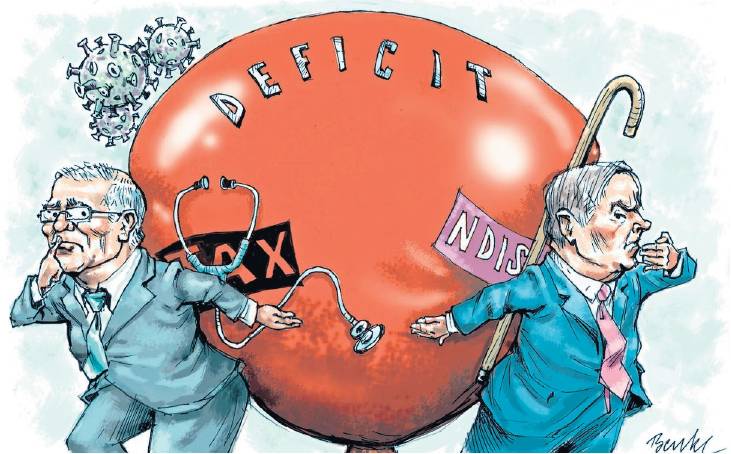
Australia has $970 billion dollars in gross debt. It will rise to a trillion dollars next financial year. Albanese says that out Defence budget will increase to 2.5% of GDP. That’s an extra $10 billion per annum, on top of a structural deficit of $50 billion a year, already rising to $70 billion.
With Stage 3 tax cuts set to kick in next year, and revenue from coal and gas exports likely to decrease, it hard to work out how AUKUS will be paid for, other than by spending cuts.
Nation building spin
The Government has started to offset concerns about the spend and placate the punter by saying that this is a nation building project. But this is just spin.
Yes, shipbuilding creates trade jobs which can be utilised in a range of different industries other than defence. The same is true for the electronic engineers and software engineers that work on submarine combat systems.
But as for where a lot of workforce investment will take place, it will be in nuclear technology. This investment will not translate into benefits for the Australian economy, because there are no plans for us to have a civil nuclear industry. Even if Australia were to take a decision to go there, the US will not grant the nuclear technology release or transfer approval.
Any investment in a nuclear workforce will be a sunk Defence cost.
Dismantling of our sovereign submarine build capability
We will see an Australian flagged nuclear submarine in our waters in the early 2030’s. At that time we will start decommissioning Collins Class submarines and the workforce in Adelaide, who carry out full cycle dockings and life of type extension. That activity will stop, and 700 jobs will go.
The Government tells us that we will start building next generation SSN AUKUS submarines in 2040. But they are wrong. Once the Adelaide workforce is disbanded, we won’t rebuild a submarine build workforce. We will just buy an AUKUS submarine from the UK, or perhaps more US Virginia class boats instead.
Opportunity cost
There is a real tension building to our north. We need to have a Defence Force that can deter and, if that fails, fight.
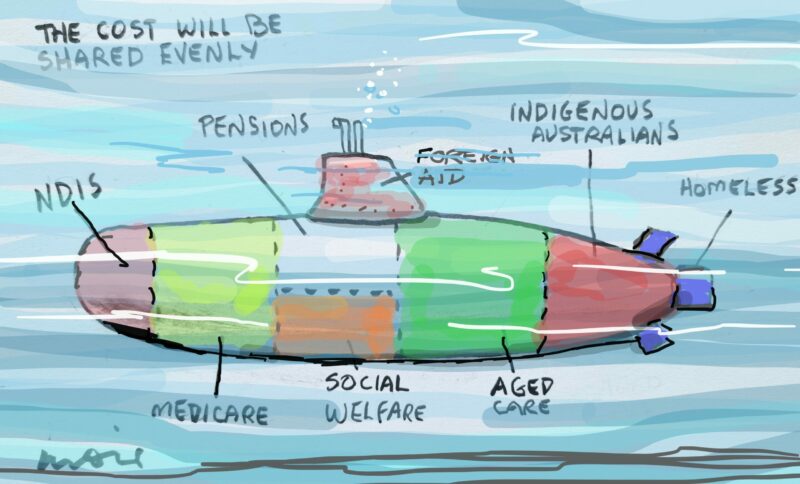
This multi-billion dollar program will come at a great opportunity cost. What significant other capabilities do we miss out on as we fund this program? In that respect there is tragedy in the way we are moving forward.

AUKUS Opportunity Cost (Source: Rex Patrick)
Will it happen?
We’ve seen our future submarine go from an Australian “Son of Collins” under Rudd, to a Japanese submarine under Abbot, to a French submarine under Turnbull, to a US and UK submarine under Morrison and Albanese. The reality is that as Governments change moving forward, and that includes in the US and UK, the program will change again. And that’s not to mention significant changes that could take place in our geo-strategic circumstances.
In 2040, when we are purportedly going to start building an AUKUS submarine here in Australia, Anthony Albanese will be 77. You and I will be reading the second edition of his political memoirs, picked up from the discount bin at the front of the local bookstore. There’ll be a different program underway.
I’d love a new Ferrari, but I’d have to pay for it, so it just won’t happen. Unconstrained by the need to pay for it themselves, the Prime Minister, supported by a few Admirals, just wants nuclear submarines.
AUKUS beneficiary: General Dynamics shipyards in Groton, Massachusetts. Photo: US Navy.
The Chief of Navy, Vice Admiral Mark Hammond, has proclaimed the AUKUS submarine program is a national building endeavour when, in fact, it’s quite the opposite. Rex Patrick pulls apart the Admiral’s claim.
Left kicking myself
About a month before Prime Minister Albanese went to San Diego for his threesome with President Biden and Prime Minister Sunak, I decided to warn Michael West Media readers that, in due course, Defence would roll out the “nation building” slogan in support of AUKUS. But I got distracted and last week the Chief of Navy invoked the phrase. So, I’m left kicking myself.
How did I know the claim was coming? Well, the admiral was singing from a very well thumbed hymn book.
My first recollection of the words “nation building” and “submarines” being used together was in 2010 when former head of the Submarine Institute of Australia, retired Rear Admiral Peter Briggs, was throwing it around in the backchannels. At the time he was pushing for Australia to build a locally designed “Son of Collins” to meet the needs of our future submarine force.
National building quickly became a cliché in Defence circles for those who wanted to sell a grandiose submarine project to government.
By 2013, a decade ago, “nation building” had made its way into the Defence White Paper.
“… the Future Submarine Program represents the largest and most complex project ever undertaken in Australia’s history. This project represents a true nation building endeavour which presents both challenges and significant opportunities for Defence and Australian industry.”
The rhetorical combination has been rolled whenever anyone raises a concern about project cost, like a decoy designed to stop a torpedo hitting its target; “National building” has been deployed a lot in the past decade; South Australia’s Defence Industry Minister before the Senate in July 2014, Defence Minister Linda Reynolds in a November 2020 keynote speech to the Submarine Institute of Australia and now Admiral Hammond.
Admiral Mark Hammond pulled at patriotic heart strings last week when he “implored Australians to see [the AUKUS submarine program] as a nation-building endeavour on par with the original creation of the Snowy Mountains Hydro-electric scheme”.
Unfortunately, his comparison just doesn’t stack up.
Snowy Hydro
The Snowy Mountains scheme was a very large and complex engineering project that diverted the waters of the Snowy River through tunnels in the mountains and stored it in dams, which were then used to create electricity. It involved the construction of nine power stations, 16 major dams, 80 kilometres of aqueducts and 145 kilometres of interconnected tunnels.
Snowy stimulated the Australian economy and created an industrial base for national security after World War Two. The Labor government of that era implemented plans for full employment, created public housing and announced it would take in 70,000 immigrants each year. It harnessed the impetus of wartime manufacturing to encourage post-war industrial production.
It has delivered Australians with an enduring economic workhorse. It’s 33 turbines can generate a maximum of 4,100 megawatts and produce on average, 4,500 gigawatt-hours of renewable electricity each year.
To this day the Snowy Mountains Scheme is still considered to be one of the greatest engineering achievements in the world, however the project is also a story of social, cultural and political changes in Australia.
AUKUS however
By contrast, what we know about AUKUS is that it will provide investment in US shipyard expansion, to be followed at a later date by an investment in UK shipyard expansion.
As Australian politicians point to a 2040 workforce (20,000; far short of that employed in building Snowy) that will purportedly see submarines being built in Australia, General Dynamics Electric Boat in Groton, Connecticut, and Austal USA in Mobile, Alabama, are actively recruiting 5,700 and 1,000 people, respectively, to work on AUKUS right now.
At some stage the flow of money will spread out to the UK’s troubled industry.
The flow of Aussie dollars to the UK will likely start occurring around the early 2030s about the same time as Collins class submarine workers at Osborne in Adelaide are finding out their jobs are gone, bearing in mind that from 2033 there’ll be no further need to conduct Collins Full Cycle Docking or Life of Type Extension work.
And while that’s all happening, Australian taxpayers will be investing billions in upskilling our engineers and technicians in nuclear technology that will have no use beyond AUKUS. Unlike the US and UK that can amortise and leverage their Defence investment in their civil nuclear industries, we don’t have one of those.
Furthermore, we must expect that US restrictions attached to the use of their submarine nuclear technology will not allow the knowledge gained in the AUKUS program to be used anywhere else in the Australian economy.
AUKUS might be a partnership, but it’s an unequal partnership and it well remain so with Australia as the dependent partner. And all for the price of just $368 billion.
There will of course be some submarines, of an unknown type, an unknown capability, at an unknown date. Does that qualify as nation building?
It’s just not nation building
I know Admiral Hammond well. I’ve served with him. I’ve socialised with him. I even offered him a job about a decade ago. He’s a smart guy who has credibility in the capability and naval operations space. He’s a strong leader, but he’s made a significant tactical error by wading into the political space with a shallow argument, in the shadows of a patriotic slogan. Sadly, he risks undermining his hard-earned credibility in doing so.
There is an economic and defence case for spending Defence money in Australia. It generates local economic activity, it builds technical and industrial capability and adds to our advanced manufacturing critical mass, it develops skills that can be employed elsewhere in the economy, it assists with critical mass and it builds the expertise necessary to sustain military capability throughout its life and in conflict. But no matter how you look at it, building foreign designed equipment under ‘licence’ for local use is not nation building.
The truth is that Defence spending is largely a sunk cost. It’s an insurance cost. Admirals, Air Marshalls and Generals would do well to appreciate that, whilst some benefit to the general economy can flow from Defence acquisition and sustainment, Defence projects, the way they are conducted in Australia, do not offer nation building opportunities.
On the other hand …
Nation building would be taking our billion dollar lithium export business and turning it into a trillion dollar battery export business, which we have not done.
National building is investing early into Industry 4.0 to become a manufacturing powerhouse, something Germany has done, but we haven’t.
Nation building is taking royalties from your finite resources and investing in industries that will outlast the resource demand, something the United Arab Emirates has done, and we haven’t.
Nation building would be establishing modern semiconductor manufacturing capability onshore, our two AUKUS allies are actively encouraging development of their onshore industries, sadly again we’re standing idly by.
There’s no plan
In November of 2021 Senator Penny Wong asked the Navy how much money had been allocated to the Nuclear Submarine Task Force; $300m over two years was the answer. For that significant investment we’re seen a ‘Kabuki Show’ in San Diego where no detail on the program were provided and a pathetic nine FAQ sheets uploaded to the government’s AUKUS website.
First and foremost, if a project is going to be truly nation building, the nation needs to know about it, understand it and embrace it. This means there has to be a plan and that plan needs to be publicly available, it cannot be entirely shrouded in secrecy, known only to the select few. As we can see there is no published industrial plan, there are no published workforce plans. Any details on AUKUS beyond top level have had to be extracted from Government under Freedom of Information laws.
Against that backdrop, and in circumstances where most people rightly see the AUKUS program as a completely unjustifiable nation crippling spend of their money, and a spend that, on the best view, only brings us new defence capability in two decades time, Vice Admiral Hammond must be expecting to draw fire for his repeating the inaccurate and misleading characterisation.
People are right to question him, no matter the gold aiguillettes he wears on his right shoulder.
I guess he just really wants his ‘Ferrari’.