

Barry Ferguson wrote Competing for Influence: The role of the public service in better government in Australia and argues today:
New corruption body won’t stop the rorts

Since it was promised by the Morrison government in 2018, some form of national integrity commission has been in the offing. And it seems our new government will go with a model along the lines proposed by the independent Helen Haines.
There is a need for the sort of body that is proposed. Unfortunately, it will not solve the problem it is setting out to address – corruption by public officials. This is because it is designed to prosecute corrupt acts rather than stop them occurring. The solution must be to stop corruption by removing opportunities for it to occur.
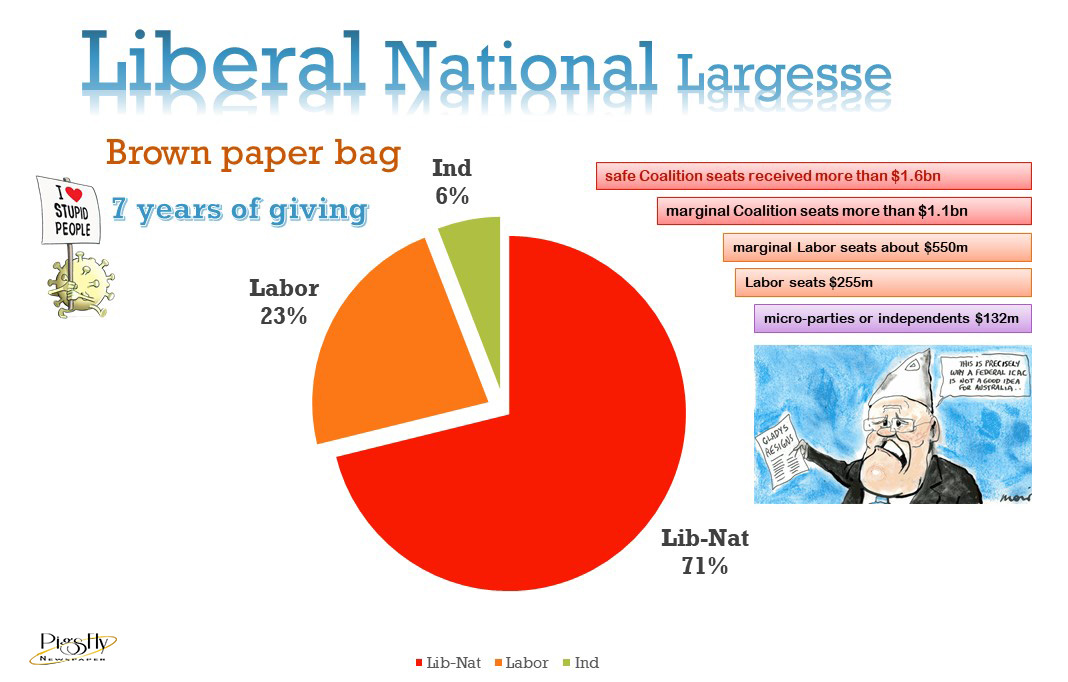
Viewed broadly, the sorts of corrupt acts we should stamp out are those that see public resources diverted to private interests. Considered in these terms, there is a wide range of political corruption that requires addressing.
It includes the use of preferred suppliers;
the appointments to plum jobs for ex-politicians;
the shortcircuiting of public service processes;
political appointments to senior public service jobs;
the overuse of certain suppliers at the expense of open tenders; and
the intrusion into public decisionmaking of the mates networks (consultants) that hang off governments.
Public resources diverted to private interest
Indeed, much of what occurs that is corrupt involves subverting ‘‘due process’’, that is the conduct of administrative proceedings according to established principles and procedures designed to create value in government for citizens.
The other source of what we should describe as ‘‘corruption’’ is a more direct disabling of the public service’s ability to advise government on what is in the best interests of the country; this invariably involves a conscious strategy to suppress it. Both of these forms of corruption are widespread in government in Australia.
To prevent both, there is much to do. Such action should include appropriate rules and their enforcement of such matters as parliamentary privilege and ministerial conduct; the reinvigoration of the freedom-ofinformation processes; adequate resourcing of public integrity bodies; and transparent accounting for spending by ministerial offices.
Preferred suppliers
Appointments to plum jobs for ex-politicians
The current processes enable delivery of personal and/or political benefits to politicians at some cost to the taxpayer. It only takes a careful look at the national lobbyist register (and the auditor-general’s criticism of it) to realise what a sham some of these codes of conduct are.
 And there is much more to be done. What is fundamentally missing from government and public administration today is accountability for budget expenditure – the $636 billion of Australian government expenditure projected for 2021-22.
Taxpayers want to hear how government spending affects their lives. This is arguably what the Public Service Act (1999) intended in requiring its objects to serve ‘‘the Government, the Parliament, and the Australian public’’.
Much of the ‘‘fix’’ involves encouraging our politicians to concentrate on what they do best – developing policy in the community and building coalitions for implementation, while allowing the public service to do what it does best, namely advising on the conversion of political and policy objectives into successful programs and on the required connections across government to integrate all relevant parts of government.
A prerequisite for an optimal public service is the creation of some distance between government and its public administration arm, replacing the prevailing commandand-control modus operandi of recent governments with one of ‘‘collaboration’’.
Under the Albanese government this could be developed around a foundation of new respect
between ministers and public servants that our new PM has pointed to.
Unfortunately, this laxity in accounting to the Australian people for the primary task of government
– a fundamental form of corruption in itself – encourages further corruption down the line.
However, we must be cognisant of the recent reminder by British philosopher A.C. Grayling that there is no more important foundation to democracy than an informed public. Embedding a culture of accountability in politics would do more to diminish ‘‘corruption’’ than any integrity commission. So while a national integrity commission may be part of the answer, it is certainly neither the complete answer nor the most important part of it.
Barry Ferguson is an author in the field of public sector management. He wrote Competing for Influence: The role of the public service in better government in Australia (ANU Press, 2019).